
Processing Capacity is Key to Success in a China-dominated Market
|
|
|
|
PERSPECTIVES No.15 | April 14, 2026
If the strategic value of graphite were just the resource itself, the West would not be playing catch-up to China.
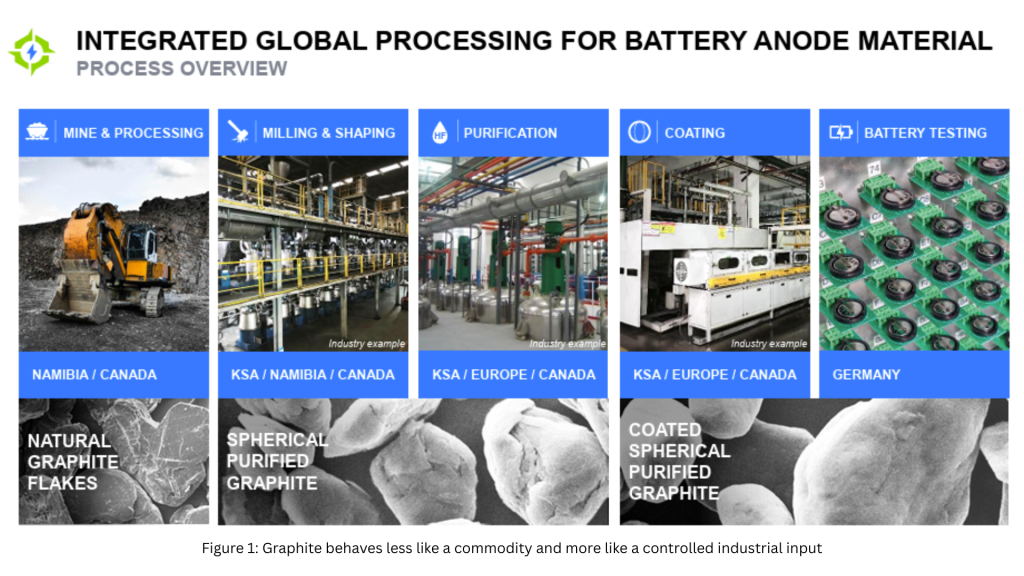
China today controls most of global graphite mining and battery anode material production. It did not achieve this by controlling the resource, but by building an integrated industrial system that connects mining, processing, and advanced materials into a single, coordinated value chain.
That’s the model that China is executing at scale, and its dominance has not only concentrated supply but allowed it to control the terms of pricing, processing, and market access. It’s a model that is tailored to an industry where pricing is opaque, relationships matter, and value is determined downstream, closer to the battery than the mine. In this context, graphite behaves less like a commodity and more like a controlled industrial input.
That system has defined the market, setting the clear precedent that to compete in graphite, you must control the pathway to the battery.
China has with its first mover advantage effectively set the rules and defined graphite as not just a mining story, but rather an industrial one where integration is the price of entry and where control of the material is critical from mine to battery.
Control over where material is processed;
Control over how it is upgraded; and
Control over how it is delivered.
Waking up the West
The West has yet to fully internalize the fact that success in the graphite game will depend not just on the availability of graphite in the ground – there is plenty of that, including in the Canadian graphite corridor in Quebec that is home to more than a dozen known, sizable deposits – but rather in the ability to build secure, scalable, and integrated supply chains capable of delivering processed, battery-grade material close to major markets.
The good news is that the West is no longer standing still, reflecting in policy the levers that define value in today’s market as demand accelerates.
Across North America and Europe, governments are introducing tariffs, localization requirements, and strategic stockpiling to reshape supply chains that reflect a broader recognition that critical mineral markets, especially in the case of graphite, must be actively engineered.
And it has to happen quickly. Demand for graphite is set to accelerate as widescale electrification gathers momentum beyond just EVs and into multiple other needs for battery energy storage systems, and global governments seek out graphite as a leading material in defense applications.
Yet, even amid research from organizations such as the International Energy Agency, World Economic Forum, and U.S. Geological Survey that points to significant growth driven by electrification and energy storage, supply chains remain concentrated, fragile, and exposed to geopolitical risk.
Opportunity
While jurisdictions like Canada can readily boast of ample graphite resource in the ground, there is a deficit in extraction capacity and processing capabilities to build battery-ready supply.
The competitive advantage will sit with those who can connect resource development to extraction, processing and upgrading, and ultimately battery anode material production. In other words, those who can build mine-to-battery supply chains.
This is not just a strategic option, but the price of entry, and countries that recognize this are already moving quickly.
The Kingdom of Saudi Arabia, for example, is positioning itself as a global critical minerals hub under its Vision 2030 strategy, aligning policy, capital, and industrial development to build fully integrated supply chains.
It has understood that to compete with China, the model must be replicated at scale and with cost discipline.

That combination, scaled upstream resources, midstream processing, and downstream materials capability, underpins Northern Graphite’s joint venture with Obeikan Investment Group to build a battery anode material plant in Yanbu by 2028 that will process graphite from our Okanjande mine in Namibia. As the only producer of natural graphite in Canada, North America, and the G-7, our strategy is not simply to mine graphite, but to industrialize it by connecting production with processing, and processing with advanced materials across a Western-aligned supply chain. For us that includes planned battery anode material facilities in Canada, Saudi Arabia, and northern France, designed to bring capacity closer to end markets while ensuring traceability, resilience, and alignment with emerging regulatory frameworks.
Global automakers are clearly signalling to Western markets that this is the way forward. Rather than sourcing materials, global battery manufacturers are sourcing entire supply chains that are secure, traceable, geographically aligned, and resilient to disruption. As a result, value is migrating, moving away from standalone mining operations and toward integrated platforms capable of delivering consistency, transparency, and alignment with end-market needs.
As we track a way forward for the graphite industry amid building demand, the defining question is not only if we have enough graphite, but rather, whether we control where it comes from, and how it gets to the battery.
Let’s Make it Happen!

Hugues Jacquemin
Chief Executive Officer, Northern Graphite
Hugues Jacquemin is the CEO of Northern Graphite and has more than 30 years senior management experience growing Specialty Materials businesses for listed Fortune 500 & Private Equity firms.
Perspectives is researched, written and produced by Northern Graphite.
